
![[:tj]МАРКАЗИ ТАДҚИҚОТИ СТРАТЕГИИ НАЗДИ ПРЕЗИДЕНТИ ҶУМҲУРИИ ТОҶИКИСТОН[:ru]ЦЕНТРА СТРАТЕГИЧЕСКИХ ИССЛЕДОВАНИЙ ПРИ ПРЕЗИДЕНТЕ РЕСПУБЛИКИ ТАДЖИКИСТАН[:en]Center for strategic research under the President of the Republic of Tajikistan[:]](https://mts.tj/wp-content/uploads/2024/11/bannereng-1.jpg)
THE ROGUN HYDROELECTRIC POWER PLANT IS A CONSTRUCTIVE ELEMENT IN SHAPING A JOINT POLICY ON WATER AND CLIMATE ISSUES IN CENTRAL ASIA
The Government of the Republic of Tajikistan, striving to achieve energy independence and as part of the implementation of reforms of the economic system, has achieved a number of significant successes. This process has contributed to the strategic development of the country in accordance with the environmental and economic conditions of the region, as well as ensured the integration of Tajikistan’s energy sector with the United Nations Sustainable Development Goals.
In this context, Tajikistan’s chosen path is in line with current global trends and is aimed at ensuring energy independence and efficient use of electricity with the priority of producing “green” energy. This measure is defined as a strategic direction for the country’s development within the framework of the National Development Strategy of the Republic of Tajikistan until 2030.
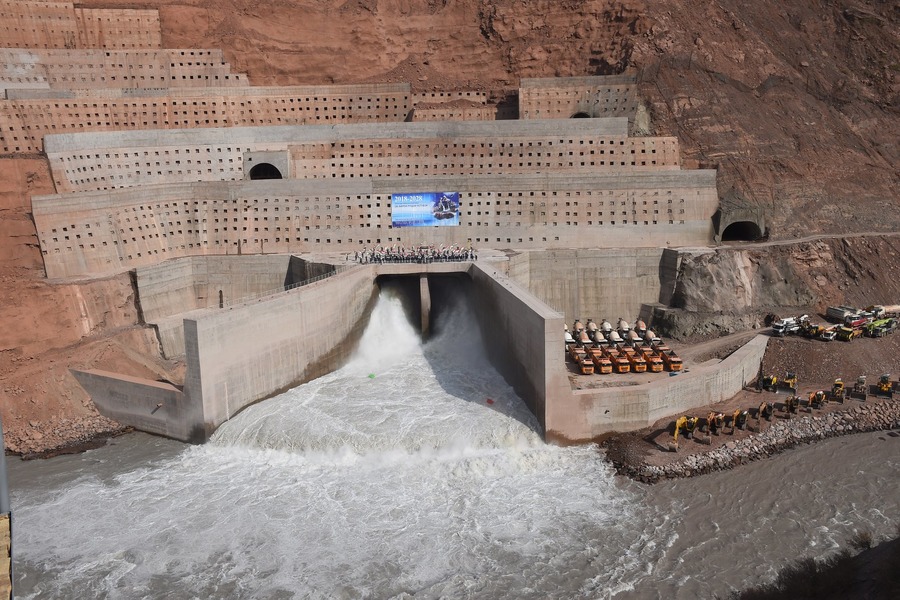
In particular, the Rogun hydroelectric power Plant (hereinafter – Rogun HPP) is one of the largest hydropower projects in the region and the construction of the century. It plays a key role in solving the most important tasks of the socio-economic development of the country – in the production of “green” energy and achieving energy independence. This not only strengthens the economic base of the country, but also the energy potential of the Central Asian states.
At the same time, in order to prevent negative consequences in good-neighborly relations, as well as to protect the environment and maintain environmental stability, which is of inter-regional interest, the Republic of Tajikistan, in cooperation with regional and international organizations, has implemented timely and useful measures.
It should be noted that in modern conditions, the problem of climate change is of deep concern to the whole world. Therefore, the rational use of natural resources, especially water resources, is one of the main principles of public policy in the countries of the world. This principle is aimed not only at meeting the internal needs of States, but also at promoting common regional interests, strengthening cooperation, stability and sustainable development at the international level.
In this regard, hydropower occupies a central place in the global energy system, being the largest renewable and environmentally friendly source of electricity generation. It is estimated that hydropower provides more than 60% of all green energy and about 16% of total global electricity production. According to the international analytical center Ember, in 2023, hydropower provided 14% (4,210 TWh) of global electricity production[1]. At the same time, the importance of hydropower is closely linked to the sustainable management of water resources. Most hydraulic structures not only produce electricity, but also provide water supply, irrigation, and prevent the possible effects of floods and floods.
In this direction, Tajikistan pursues a balanced foreign policy based on the principles of solidarity and good-neighborliness in all areas of cooperation with neighboring States. According to article 11 of the country’s Constitution: “Tajikistan pursues a peaceful policy, respects the sovereignty and independence of other States, and defines its foreign relations based on international norms.”[2]
In this regard, the President of the Republic of Tajikistan, Honourable Emomali Rahmon, has repeatedly stressed in his addresses to the Majlisi Oli of the Republic of Tajikistan, as well as from high regional and international rostrums, that Tajikistan will never implement a project that will harm its neighbors[3]. A series of initiatives by the Leader of the nation in the field of water and climate, meeting the interests of all mankind, testifies to the immutability of our country’s position.
In particular, the construction of the Rogun HPP is a large-scale and strategic project, which, according to international experts, is a means of bringing both Tajikistan and other countries in the region to a new level of energy and economic sustainability.
In other words, in this context, priority is given to strengthening the capacity to meet the needs of the region’s residents, which contributes to achieving energy independence and developing a green economy, as well as strengthening the economic stability of the region’s States.
Thus, Tajikistan, as a sovereign subject of international relations, is obliged to increase its energy potential in order to ensure the well-being of its citizens. The hydropower potential of our country is more than 500 billion kWh per year, of which only 4% is currently used[4].
In addition, in modern conditions, investment trends in hydropower are a logical and timely step. After all, it is the stabilization of energy supply that creates a solid foundation for the modernization of industry, agriculture and social programs.
Back in 2014, Robert Zwahlen, speaking about the goals of the Rogun HPP project, recalled that “the World Bank supported the initiative of the countries of Central Asia and Tajikistan to conduct two studies to assess the consequences of the construction of the Rogun HPP.”
In other words, internal and international experts have studied the technical, economic, socio-environmental aspects of the project in accordance with international standards and global practice, based on recommended alternatives. Studies have shown that the construction and operation of the Rogun HPP will not lead to a decrease in water volumes for the underlying countries, on the contrary, it will significantly extend the service life of the Nurek HPP and the cascade of HPPs on the Vakhsh River[5].
In turn, extending the life of the cascade of hydropower plants on Vakhsh creates new opportunities for the Amu Darya and prolongs its viability, which is beneficial for all neighboring countries. Therefore, the Rogun HPP is considered as a driving force of positive regional changes.: It makes it possible to modernize water resources management, invest in the restoration of natural ecosystems, introduce economical irrigation and resource-efficient production. Such investments will contribute to the stabilization of the situation in the Aral basin, since the water level and volume of the Aral Sea have decreased significantly since 1960.
In general, taking into account the prospects for sustainable development, the Rogun HPP can become part of the unified energy system of Central Asia and embody region-wide interests. The Rogun HPP is not just a hydropower project, but a strategic opportunity for the countries of the region, as well as reasonable regulation, international participation and compliance with environmental standards will contribute to sustainable development, regional cooperation and a new water and energy policy.
[1] Analysis of the different electricity sources in 2023 // Ember. [Electronic source]. Access to the source: URL: https://ember-energy.org/chapter/global-electricity-source-trends/ (date of request: 23.04.2025).
[2] The Constitution of the Republic of Tajikistan dated November 6, 1994, with amendments and additions dated September 26, 1999, June 22, 2003 and May 22, 2016 (in Tajik and Russian). Dushanbe: «Ganj Publishing House», 2016, p. 135
[3] H.A. Safarzoda. Rogun – events and people // Safarzoda Khairullo Amirali. Dushanbe. 2022. 542 p.
[4] Participation in the 66th meeting of the CIS Electric Power Council // Ministry of Energy and Water Resources of the Republic of Tajikistan. [Electronic source]. Access to the source: URL: https://www.mewr.tj/?p=4582&lang=tj (date of request: 04/25/2025).
[5] E. Nazarov. “Rogun” does not reduce the volume of water / / Republic, No. 164. 2014. 08/20/2014.
Fattoev Masrour Saidmurodovich,
Deputy Head of the Department for Analysis
and Forecasting of Internal Policy at the
Center for Strategic Research under the
President of the Republic of Tajikistan